

The word Ayurveda is of Sanskrit origin, consisting of two words: ayu – life and veda – knowledge, meaning the science of life. It is one of the world’s oldest holistic healing methods, encompassing the entire body, which considers and treats not only the diseased organ or body part but the entire human organism. This encompasses the entire person – body, mind, and soul – including their environment and lifestyle.
The first written records of Ayurveda are found in the Vedas, the sacred scriptures, which represent the
oldest and most extensive body of knowledge in history. Rooted in the wisdom of sages and seers, Ayurveda developed from a profound understanding of the interactions between humans and nature. Its creation lies within the Vedic texts, particularly the Atharva Veda, where ancient sages documented their observations, experiments, and insights into health, well-being, and the intricate balance of body, mind, and spirit.
The fundamental principle of Ayurveda is balance, equilibrium. Ayurveda is recommended for use in two ways:
- For prevention: by maintaining and balancing a healthy body, mind, and soul, which includes important aspects such as thought, exercise, breathing, nutrition, cleansing, and our rest and their methods.
- For treating illnesses: While Western medicine aims to relieve patients of their symptoms in case of illness, Ayurveda, based on its holistic approach, restores the entire person to a state of balance, thereby creating a natural state of health.
A crucial element of Ayurveda is the understanding that individuals are genetically distinct, each possessing a unique constitution, and thus react individually to environmental influences. Each person knows best what their body needs. Ayurveda provides guidance on how to modify our lifestyle to achieve optimal bodily function. If we fall ill, Ayurveda helps restore balance exclusively through the use of natural substances and methods, including diets, exercise, lifestyle adjustments, and therapeutic approaches. This ancient healing system emphasizes the paramount role of mental health in preserving our physical well-being. In each of the eight branches of Ayurveda, the emphasis is on prevention.
Every human body is composed of five elements: earth, water, fire, air, ether. In Ayurveda, these five elements combine into three qualities:
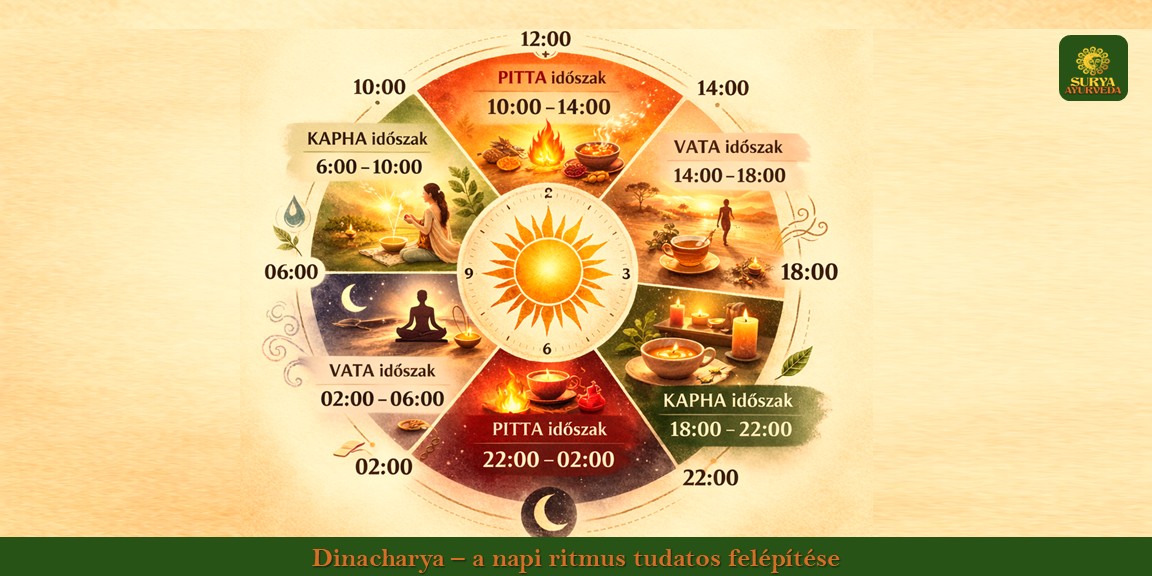
These three energetic principles in the body – vata, pitta, kapha – are responsible for each person’s prakriti, or individual constitution. The
Each of the three doshas contains two of the five elements. Vata consists of air and ether, pitta contains fire and water, while kapha, with earth and water, is the heaviest dosha.
Characteristics and Functions of the Three Doshas
Vata: a Combination of Ether and Air Elements
Vata is the principle of movement. What moves is called Vata. Bodily air, or Vata, can be characterized as the energy that governs biological movement. Vata controls respiration, blinking, the movement of muscles and tissues, and the impulses of nerve cells. Vata also governs feelings and emotions such as freshness, nervousness, fear, restlessness, pain, tremors, and spasms.
The large intestine, pelvic cavity, bones, ears, and hips are Vata areas. If too much Vata accumulates in the body, it collects in these areas.
Characteristics of Vata: Cold, light, quick, dry, mobile, subtle, rough.
Functions: It represents bodily functions related to movement. It governs the activities of the nervous system and the excretory process.
Pitta: Dominance of Fire Elements
The bodily fire, Pitta, manifests as metabolism in our body. Pitta controls digestion, absorption, nutrition, metabolism, body temperature, skin complexion, the luster of the eyes, as well as intelligence and understanding. Psychologically, Pitta generates passion, anger, hatred, and jealousy.
The small intestine, stomach, sweat glands, blood, fat, eyes, and skin are the seats of Pitta.
Characteristics: Warm, light, sharp, slightly oily, liquid, pungent in taste.
Functions: It represents bodily functions related to heat and metabolism. It governs the digestive functions of the body.
Kapha: a Combination of Water and Earth Elements
Kapha holds together the elements in the body, thus creating the material of the physical structure. It lubricates the joints, provides moisture to the skin, helps heal wounds, fills the cavities in the body, provides biological strength and stability, aids memory, gives energy to the heart and lungs, and maintains immunity.
Kapha is present in the chest, throat, head, bone marrow, nose, mouth, joints, stomach, cytoplasm, plasma, and the body’s liquid secretions. Psychologically, Kapha is responsible for feelings of attachment, greed, and prolonged envy, and also manifests in aspirations towards calmness, forgiveness, and love. The chest is a prominent area for Kapha.
Characteristics: Cold, heavy, oily, sweet, solid, slow, soft, sticky.
Functions: It is responsible for appearance, biological strength, natural tissue resistance, and proper bodily structure.
The balance of the three doshas (tridosha) is essential for health. For example, the principle of air sustains the bodily fire, but water is also necessary to limit this fire, otherwise the bodily fire would burn the tissues. Together, the tridosha governs all metabolic activities.
Accordingly, it is fundamentally important to know which constitution, or its variations – what bi- and tridosha combination – characterizes a given person, and based on this, the Ayurvedic expert can recommend personalized diets, lifestyles, and treatments for healing the body and preventing illnesses.